Bat community structure in urban green areas of northeastern Brazil
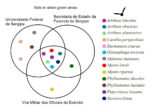
Rayanna Hellem Santos Bezerra, Adriana BocchiglieriThe structure of the habitat can influence the bat community, limiting the species to use certain environments. Considering the more tolerant species, these can be found in forest fragments surrounded by urban matrix or heavily wooded places. This study aimed to characterize the bat community in the urban green areas of Greater Aracaju, Sergipe. The campaigns were conducted during two consecutive monthly nights in each area. Bats were captured using 10 mist nets. The abundance, richness, diversity, and composition of bats were characterized for each area. In addition, the models of abundance and sufficiency of the sampling effort were evaluated. We captured 599 individuals, representing 13 species in three families, with an effort of 77.760 m²/h. Secretaria de Estado da Fazenda de Sergipe had the highest value of the diversity index (H’ = 1.78), followed by Universidade Federal de Sergipe (H’ = 1.62) and Vila Militar dos Officiais do Exército (H’ = 1.55), with a difference observed only between the SEFAZ and Vila areas. The observed richness was lower than expected in all areas. Only the UFS and SEFAZ differed in species composition. For urban green areas in the state, Artibeus planirostris and Myotis riparius correspond to the new records. The observed difference in diversity between the SEFAZ and Vila may be associated with the greater evenness of the SEFAZ and the dominance of Artibeus lituratus in Vila. This study provides relevant information on the subject, highlighting the need to obtain a better understanding of this group in urban green environments.
Estrutura da comunidade de morcego em áreas verdes urbanas do nordeste do Brasil. A estrutura do habitat pode influenciar a comunidade de morcegos, limitando a espécie a utilizar determinados ambientes. Considerando as espécies mais tolerantes, estas podem ser encontradas em fragmentos florestais circundados por matriz urbana ou locais fortemente arborizados. Este estudo teve como objetivo caracterizar a comunidade de morcegos nas áreas verdes urbanas da Grande Aracaju, Sergipe. As campanhas foram realizadas durante duas noites mensais consecutivas em cada área. Os morcegos foram capturados com 10 redes de neblina. Para cada área, foram caracterizadas a abundância, riqueza, diversidade e composição de morcegos. Além disso, foram avaliados os modelos de abundância e suficiência do esforço amostral. Foram capturados 599 indivíduos, representando 13 espécies de três famílias, com um esforço de 77,760 m².h. A Secretaria de Estado da Fazenda de Sergipe apresentou o maior índice de diversidade (H’ = 1,78), seguida pela Universidade Federal de Sergipe (H’ = 1,62) e Vila Militar dos Oficiais do Exército (H’ = 1,55), com diferença observada apenas entre as áreas SEFAZ e Vila. A riqueza observada foi menor que a esperada em todas as áreas. Apenas a UFS e a SEFAZ diferiram na composição de espécies. Para as áreas verdes urbanas do estado, Artibeus planirostris e Myotis riparius correspondem aos novos registros. A diferença de diversidade observada entre a SEFAZ e a Vila pode estar associada à maior equitabilidade da SEFAZ e à predominância de Artibeus lituratus na Vila. Este estudo fornece informações relevantes sobre o assunto, destacando a necessidade de se obter um melhor conhecimento desse grupo em ambientes verdes urbanos.